Developmental Milestones Series- Speech and Language

Speech and language development continues to evolve as children progress through their early school years, from kindergarten through Grade 3. During this time, children typically build upon the foundational language skills they acquired in their preschool years and continue to develop more advanced language and communication abilities. Here is a general overview of what you can expect for students in kindergarten through Grade 3:

Kindergarten to Grade 1:

1. Vocabulary: Students in K3 to G1 should be expanding their vocabulary significantly. They are learning new words every day and becoming more adept at naming objects, describing things, and asking questions.

2. Sentence Structure: At this stage, children are transitioning from simple sentences to more complex ones. They may use conjunctions (e.g., “and,” “but”) to join ideas and form compound sentences.

3. Communication Skills: Students in K3 to G1 are learning to communicate effectively with peers and adults. They should be able to engage in conversations, express themselves clearly, and listen and respond to others appropriately.

4. Reading and Writing: In the early grades, children learn to read and write. They develop phonemic awareness, letter recognition, and begin to understand the concept of written language. Simple sentences and stories are introduced.

Grade 2 (G2) to Grade 3 (G3):

1. Vocabulary: Students continue to expand their vocabulary, becoming more proficient in using a wide range of words to express themselves and understand increasingly complex texts.

2. Sentence Structure: By G2 and G3, students should be capable of constructing more intricate sentences, using a variety of sentence types (declarative, interrogative, imperative, and exclamatory).

3. Communication Skills: They become more skilled at engaging in discussions, debates, and presentations. They can express their thoughts and ideas coherently and provide reasons for their opinions.

4. Reading and Writing: Reading comprehension and writing skills continue to develop. Students read more complex texts and produce more extended pieces of writing, including narratives, informational texts, and persuasive essays.

5. Grammar and Punctuation: They refine their understanding of grammar rules and start using punctuation correctly in their writing.

6. Critical Thinking: In G2 and G3, students are encouraged to think critically, analyze texts, and draw conclusions. They learn to use evidence to support their ideas.

It’s important to note that individual variations in language development exist. Some students may progress more quickly or slowly than others. Teachers and parents play a crucial role in supporting language development through reading, conversation, and exposure to a rich language environment.

If a child is experiencing significant difficulties with speech and language development in grade 2 or grade 3, it may be beneficial to seek guidance from a speech-language pathologist or an educational specialist to address any specific challenges and provide additional support. Early intervention can be vital to helping students succeed in their academic and social development.

Prepared by Jakim Campbell, AA

Administrative Assistant at Jabneh Christian Academy

Joy! We’ve Got Joy.

Our value word for the month of June is JOY

We have intentionally pulled joy to the foreground as it can get lost in the myriad of disappointments, challenges, anxious moments, and lawlessness that appears to occupy the scene constantly.

Joy is not happiness.

Joy is not the result of being healthy, wealthy, or smart.

A friend of mine lost her beloved mother this week. We started conversing a few hours after and though it was obvious she was mourning she exuded such joy.  As a matter of fact, she told me that she was mourning not mournful.  Can you imagine that!

We can, if we understand James 1:2-3 which states,

Dear brothers and sisters,[a] when troubles of any kind come your way, consider it an opportunity for great joy. For you know that when your faith is tested, your endurance has a chance to grow.”

Weeping is not indicative of the absence of joy.  Joy is rooted in Christ Jesus.  The fullness of joy is found in Him.

No matter what comes, we have joy.  For the month of June, we pray that you will experience the fullness of joy.

Joy Overflow- We do not own the rights to the song. Dancer- Icon Ajahne Reid

Hug Them, Please

Once we have our arms, we can make an indelible mark.

Of all the uses of our arms, hugging our children is one of the most important uses.

As a village, we are on an extended prayer marathon which has inspired the thought I have coined as intercessory embrace. This is the act of pulling someone into an embrace with the intention to beseech God on his/her behalf overtly or covertly.

Hugs are reassuring. Our children need constant reassurance. There are many things, on a daily basis, which have the potential to cause a feeling of overwhelm for these small, immature human beings. It cannot be ok for them to be left to navigate the frights of life, the anxieties, the highs and lows on their own. Time may be scarce for their caregivers, but to hug, definitely will not topple our boats if we pause to just hug our children.

Denying our children of the benefits of our hugs can cause damage for a very long time. On the other hand, hugging our children can, and will result in returns that far exceeds our expectations. Pause and think about what a hug does for you, an adult.

Did you know that hugging your children can:

•        Help to curb undesirable behaviours

•        Help to lesson trauma

•        Give a sense of safety

•        Boost their confidence

•        Increase performance in school

•        End temper tantrums

•        Improve health

•        Helps with stress management and

•        Improve the parent-child bond.

Can we depend on you to make a difference by making a habit of hugging your child/children?

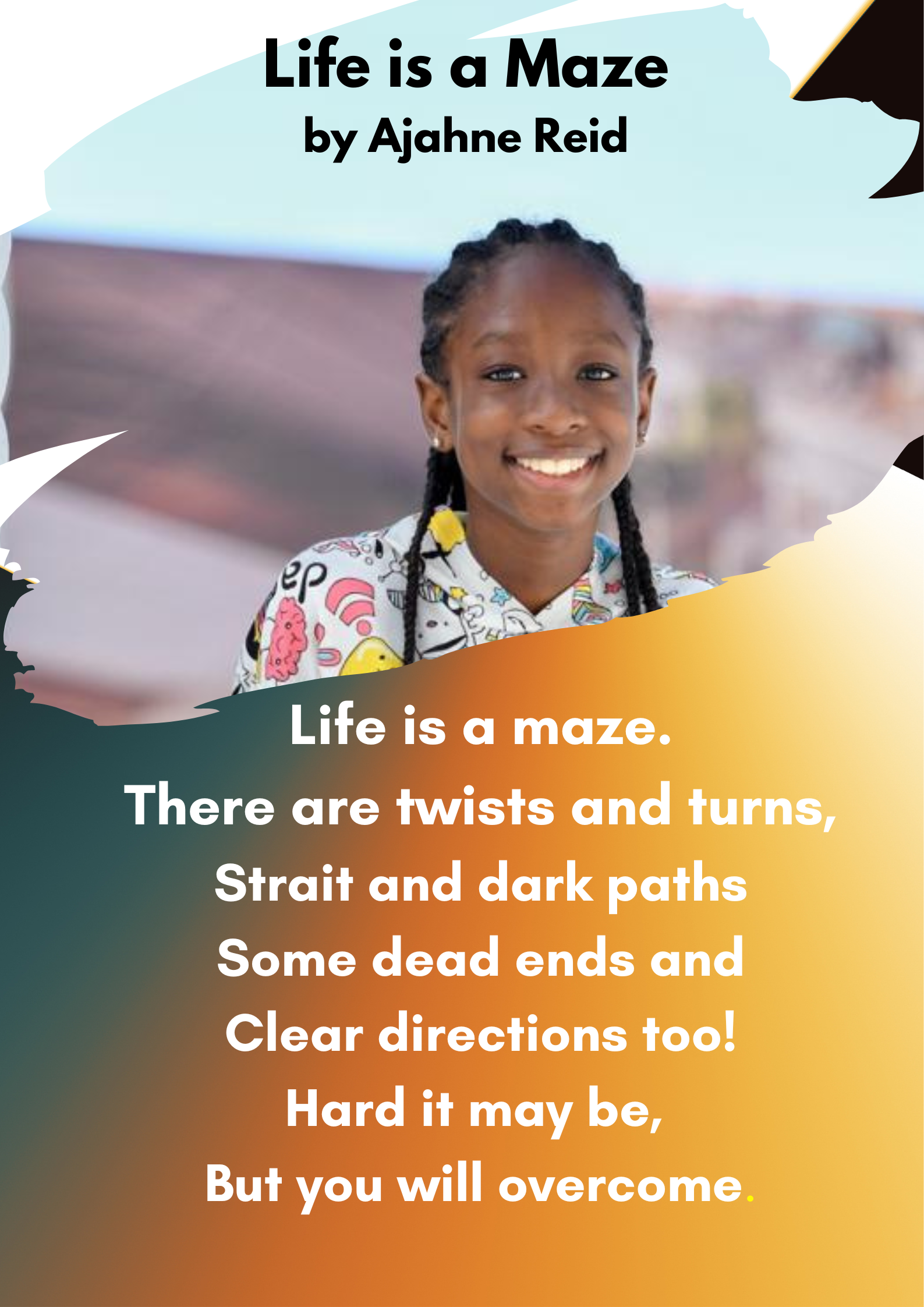
Icon Ajahne Reid’s First Poem

When the language lesson finds a poetess…  This icon is now learning about figures of speech.  Can you tell the figure of speech that she employs to compose this masterpiece in her first class?

Icon Robyn Jackson’s Crochet Swimwear Collection

The word crochet comes from the French word croche which means hook. Crochet has come a long way and is evolving into a fashion statement. 

At Jabneh Christian Academy, the art programme is unique as it seeks to develop the talents the icons possess or the areas in which they show avid interest.

Therefore, our Art sessions are very individualized. Icon Robyn Jackson is developing into a crocheter and we are sharing her talent with you.  She crochets for all this craft’s benefits, including an income stream.  Do contact her mom at 876 480 8406 to place an order in support of this young entrepreneur.

Super sophisticated mathematics skills- Justin Golaub

While many seven-year-olds are expected to add and subtract numbers with sophisticated strategies, including counting from the number with more value for addition and backward for subtraction, icon Justin Golaub is counting by 145s. This is super sophisticated.

#jabnehchristianacademy

#wenurture

#weenlighten

#webuild